Holding the Five Arrows of Subtle Elements (Pancatanmatrasayaka)
Understanding the five arrows held by Lalitha Tripurasundari and their deeper meaning in Sri Vidya.
published on: Jul 22, 2026
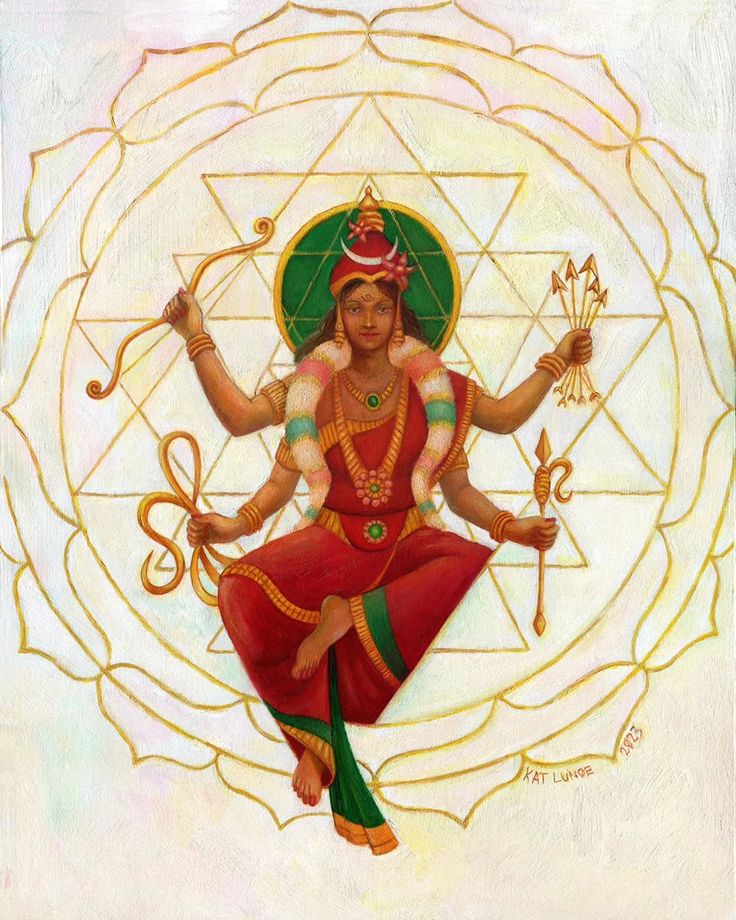
In the previous posts, we explored the four weapons held by Lalitha Tripurasundari. We saw the noose representing attachment, the goad representing divine correction and knowledge, and the sugarcane bow representing the mind.
Now we move to the final weapon among the four, the five arrows held in Her upper-left hand.
The eleventh name of Sri Lalitha Sahasranama describes the devi as: Pancatanmatrasayaka, who holds the arrows made of the five subtle elements.
To understand this name, we first need to understand what tanmatras are and why they are described as arrows.
Five senses as Arrows
The word tanmatra refers to the subtle essence behind our sensory experiences.
पञ्चसंख्यानि तन्मात्राणि शब्दादीनि विषयाः ।
The five tanmatras are:
- Shabda - sound
- Sparsha - touch
- Rupa - form
- Rasa - taste
- Gandha - smell
These are not the physical objects that we experience through our senses. They are the subtle principles behind those experiences.
According to Maha-Svacchanda Sangraha:
भूतमात्रस्वरूपोऽर्थविशेषाणां निरूपकः ।
A tanmatra is the invisible, subtle blueprint or sensory potential that gives physical objects their specific characteristics.
For example, the sound we hear is a manifestation of the subtle principle of sound. The colors we see, the tastes we experience, and the fragrances we perceive all arise from their respective essences.
The text explains:
शब्दस्तु शब्दतन्मात्रं मृदुतीक्ष्णविनिश्चयः ।
विशिष्टस्पर्शरूपश्च स्पर्शतन्मात्रसंज्ञकः ।
नीलपीतत्वशुक्लत्वविशिष्टं रूपमेव च |
रूपतन्मात्रमित्युक्तं, मधुरत्वाम्लतायुतम् |
रसतन्मात्रसंज्ञकं तु, सौरभ्यादिविशेषतः |
गन्धः स्याद्गन्धतन्मात्रं, तेभ्यो वै भूतपञ्चकम् ।
The five tanmatras manifest as:
- Sound (Shabda): basis behind different sounds and vibrations.
- Touch (Sparsha): basis behind sensations such as heat, cold, softness, and roughness.
- Form (Rupa): basis behind colors, shapes, and visual perception.
- Taste (Rasa): basis behind different tastes such as sweetness and sourness.
- Smell (Gandha): basis behind different fragrances.
These five tanmatras are represented as the five arrows held by Lalitha Devi.
Five elements as Arrows
The five arrows can also be understood as representing the five elements (Panchabhutas):
- Earth (Prithvi)
- Water (Apas)
- Fire (Agni)
- Air (Vayu)
- Space (Akasha)
तदेव तन्मात्रं पञ्चभूतानामेतदेव रूपमित्यर्थः ।
The subtle tanmatras become the physical elements that form the physical universe.
Everything we experience through our senses is ultimately connected to these five elements. Our body, the world around us, and all objects of experience arise from these fundamental principles.
By holding these arrows, Lalitha Tripurasundari is shown as the source and controller of the entire process of creation, from the most subtle level to the physical universe.
Three Levels of the Divine Arrows
As we discussed earlier while understanding Her divine form, the Goddess can be vizualised in three ways:
- Sthula - the physical form
- Sukshma - the subtle form
- Para - the supreme form
The same five arrows can also be understood at these three levels.
The Kadimata explains:
कादिमतेपि ।
‘बाणास्तु त्रिविधाः प्रोक्ताः स्थूलसूक्ष्मपरत्वतः ।
स्थूलाः पुष्पमयाः सूक्ष्मा मन्त्रात्मानः समीरिताः ।
पराश्च वासनायां तु प्रोक्ताः स्थूलान् शृणु प्रिये।
“The arrows are of three types: physical (sthula), subtle (sukshma), and supreme (para). The physical arrows are made of flowers, the subtle arrows are of the nature of mantras, and the supreme arrows are the impressions (vasanas) within.”
So the same arrows can be understood in three different ways.
Five Flowers as Physical Arrows
In Her physical form, the arrows are shown as five flowers.
कमलं कैरवं रक्तं कल्हारेन्दीवरे तथा ।
सहकारकमित्युक्तं पुष्पपञ्चकमीश्वरि ॥
The five flowers are:
- Kamala - Lotus
- Kairava - White Water Lily
- Rakta Kalhara - Red Water Lily
- Indivara - Blue Water Lily
- Sahakara - Mango Blossom
These flowers show the beauty and attraction of the Goddess’s power.
The Subtle Arrows as Mantras
At the subtle level, these arrows are understood as mantra energies.
Just as sound creates a vibration in the external world, mantras create subtle vibrations within the mind and consciousness.
The Divine Mother’s arrows are therefore not only sensory experiences but also the sacred sounds that transform consciousness.
This is why mantra is given such importance in Sri Vidya. The same power that creates the universe also becomes the means to return to its source.
The Supreme Arrows as Vasanas
The deepest meaning of these arrows is at the level of the mind. At the supreme (para) level, these arrows represent the way sensory experiences enter our mind and create impressions (vasanas).
To understand this, think about how an arrow works. An arrow is released from a bow, travels toward its target, and creates an effect when it reaches the target. In the same way, the objects we experience through our five senses become like arrows entering the mind.
A beautiful sight, a pleasant sound, a delicious taste, or any enjoyable experience first appears as a simple perception. But after reaching the mind, it creates an impression. That impression gives rise to attraction, desire, attachment, and finally influences our thoughts and actions.
For example, a child sees a toy for the first time. Initially, it is just an object. But after the mind experiences happiness from that toy, an impression is formed: “I like this. I want this.”
Repeated experiences strengthen this impression, and eventually it becomes a desire. This movement from perception to desire is what these supreme arrows describe.
The five arrows are therefore not external objects. They represent the subtle process by which the world influences our inner mind.
Different Tantric traditions describe these stages using different names. Although the words differ, they explain the same inner journey: how attraction arises, grows stronger, and eventually captures the mind.
| Kalika Purana | Jnanarnava Tantra | Tantraraja Tantra | Meaning |
|---|---|---|---|
| Harshana (Gladdening) | Kshobhana (Agitating) | Madana (Intoxicating) | The first attraction appears. The mind becomes excited by an object. |
| Rocana (Appealing) | Dravana (Melting) | Unmadana (Maddening) | The mind begins to develop attachment and emotional involvement. |
| Mohana (Deluding) | Akarshana (Attracting) | Mohana (Deluding) | The attraction becomes stronger, and the mind becomes absorbed in the object. |
| Shoshana (Withering) | Vashya (Subjugating) | Dipana (Inflaming) | The desire starts controlling the mind and weakens discrimination. |
| Marana (Destroying) | Unmada (Madness) | Shoshana (Withering) | Uncontrolled attachment destroys clarity and spiritual awareness. |
These five stages explain how ordinary experiences can bind the mind. However, Sri Vidya does not view these powers as something separate from the Goddess. Lalitha Devi holds these arrows because She is the master of the very forces that move the mind.
When the mind is turned outward, these arrows create bondage through desire and attachment. When the same mind is purified and turned toward the Divine, these very forces become a means of spiritual transformation.
Thus, the supreme arrows reveal both sides of experience: how the world binds the mind, and how the Divine Mother guides the same mind toward liberation.
Conclusion
The sugarcane bow represents the mind, and the five arrows represent the subtle forces that influence the mind.
Together, they describe the entire process of experience:
- The mind receives impressions.
- The impressions create desires.
- Desires influence our actions.
Lalitha Tripurasundari holds these arrows because She is the controller of these forces.
For an ordinary person, these arrows can become the cause of bondage. But through devotion, knowledge, and spiritual practice, the same forces become a path toward liberation.
She alone controls the mind, the senses, and the universe that arises from them.
पञ्चतन्मात्रसायिकायै नमः ॥
Salutations to Her who holds the five arrows of the subtle elements.