Understanding the 'Sri'
Let's explore the profound meaning of 'Sri', the prefix to her first three names, before diving into the remaining names.
published on: Jul 6, 2026
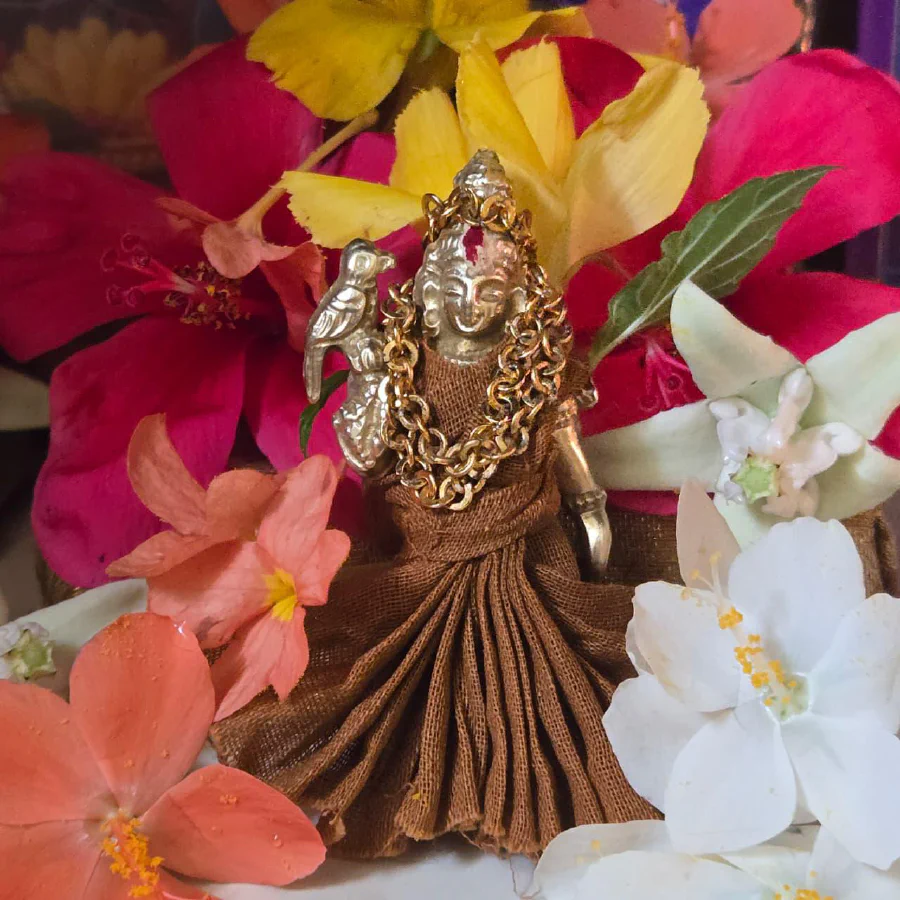
In our journey so far, we have seen that the first three names of the Sahasranama describe the Divine Mother as the ultimate Brahman, performing the primary cosmic roles: the creator (Sri Mata), the preserver (Sri Maharajni), and the destroyer (Srimat Simhasanesvari).
From the fourth name onward, the Sahasranama begins to describe her physical beauty, her mahatmyam (glory), and the remaining two cosmic functions of Brahman: tirodhana (concealment) and anugraha (grace and blessing).
But before we move forward, let’s take a moment to understand the common thread woven through these first three names.
Sri as Her True Name
In Sri-Mata, Sri-Maharajni, and Sri-mat Simhasanesvari, the word “Sri” serves as a common prefix. While it acts as an honorific adjective (meaning auspicious or holy), it is fundamentally the name of the Goddess herself.
The central deity of this Sahasranama is “Sri”. The spiritual path dedicated to her is Sri Vidya and her sacred yantra is the Sri Yantra. At her core, the Goddess we seek is “Sri” itself.
The Dictionary Meaning of Sri
According to traditional Sanskrit lexicons, “Sri” carries multiple auspicious meanings. It represents Lakshmi, Saraswati, the Earth (Dhatri), prosperity, success, beauty, means of subsistence, ornamentation, wisdom, and the first day of the lunar fortnight.
So, she as sri is the means of the subsistence. And she is the form of all wisdom.
Sri as the Bija Mantra
In Mantra Shastra, Srim is the supreme bija mantra of the Mahadevi. Interestingly, when we chant the first three names of the Sahasranama, we are unknowingly invoking this powerful seed syllable:
As we know there are some very special root letters used in mantra vidya. And Srim is the word bija mantra of the mahadevi. Without knowing we are reciting this beeja in these three names (Srim-ata), (Srim-a-ha-rajni) and (Srim-atsimhasanesvari).
The seed syllable (bija) Srim consists of three primary sounds: ‘Sa’, ‘Ra’, and ‘Em’ — along with the nasal nada:
- Sa: Represents ananda (bliss).
- Ra: Represents tejas (illumination) and jnana (wisdom), associated with the element of fire (Agni).
- Em: The Shakti (energy) bija mentioned in the Vedas.
Therefore, as “Sri”, She is the embodiment of wisdom, bliss, and power (jnana, ananda, and shakti swaroopini).
Sri as the Ultimate Refuge
श्रीयते आश्रीयते इति श्रीः
From an etymological perspective, “Sri” means the Ashraya Shakti—She who is the ultimate refuge for all beings wandering in this samsara (cycle of worldly existence). She is the Aadhara Shakti, the foundational support of everything.
One commentator also said: Sri also means the Shakti who resides in and takes refuge in the Paramatma (the Supreme Soul).
Sri as Shruti (The Vedas)
ऋचः सामानि यजूंषि । सा हि श्रीरमृता सताम् ॥
This beautiful Vedic verse translates to: “The Rig, Sama, and Yajur Vedas — they are indeed the immortal (Amruta) wealth (Sri) of the righteous.”
In this context, “Sri” refers to the Vedas themselves. She is the Shruti (the revealed scriptures), the Mother of the Vedas (Sri mata), and the eternal wisdom contained within them (Sri maharajni).
Conclusion
Because “Sri” is the fundamental essence of Bhagavati, understanding it deeply lays the groundwork for the rest of our study. By meditating on these profound meanings, our recitation of the Lalitha Sahasranama evolves from a simple chant into a deeply transformative spiritual practice.
Next time you chant the Lalitha Sahasranama, remember that you are not just reciting verses, but also unknowingly chanting powerful mantras.